Why Calm Should Come to You

The simple idea behind Sōl — and why it could change how we handle stress.
Here's something strange about modern wellness technology: it's gotten very good at telling us we're stressed, and almost no good at helping us do anything about it.
Your smartwatch can see your heart rate climb. Your fitness ring can flag a rough night. The data is everywhere. But in the moment that actually matters — when your chest tightens before a hard conversation, when the anxiety creeps in at 2 a.m. — all that technology does is hand the problem back to you. You seem stressed. And then it waits for you to fix it yourself.
That gap — between knowing and helping — is the whole reason Sōl exists. And closing it could matter more than it sounds.
Why the timing of help is everything.
Stress isn't just unpleasant; it has real, documented effects on the body and mind. And the research on managing it points to something important: interventions work best when they happen early, before a stress response fully escalates. The problem is that early is exactly when we're least able to help ourselves. When you're overwhelmed, you don't remember the breathing technique. You don't open the app. You don't reach for the calming tools across the room. The very thing that would help requires a clarity that stress takes away.
So what if the help didn't wait for you to ask?
Why does scent reach us so fast?
There's a reason aromatherapy has been used for calm across cultures for thousands of years — and modern science offers a clue as to why. Smell is the only sense wired directly to the limbic system, the brain's emotional center, without first passing through the rational filters. That's why a scent can shift how you feel before you can explain why. Compounds like lavender and chamomile have been studied for their calming, anxiety-easing effects, delivered through that remarkably direct pathway.
It's one of the gentlest, most accessible forms of relief there is. The only catch has always been availability — a bottle of lavender oil can't help you if it's in a drawer when the moment hits.
Why automatic matters
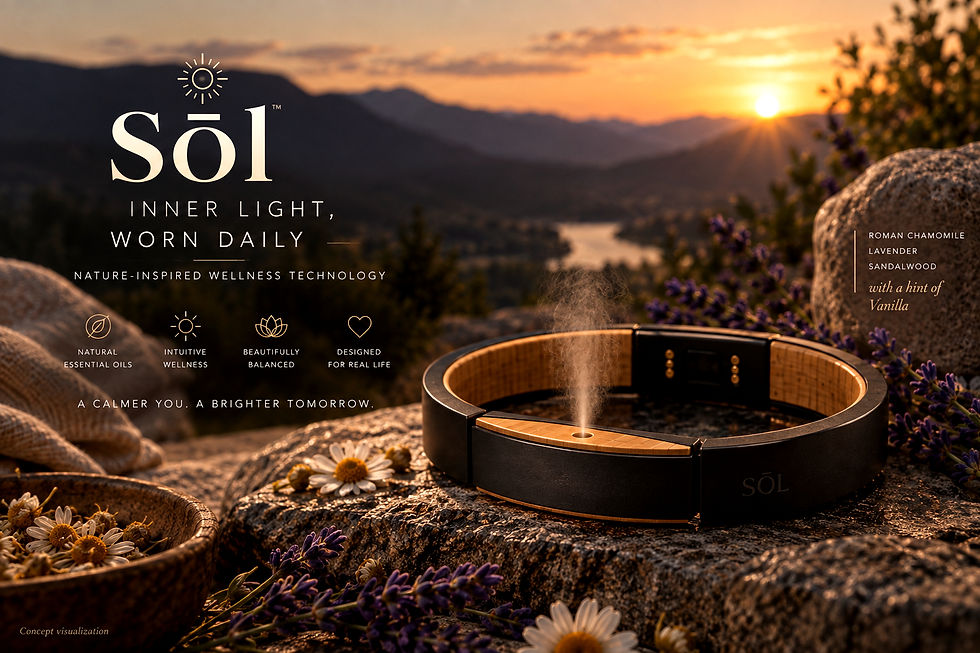
Put those two ideas together, and you arrive at the thinking behind Sōl: a wearable that watches for genuine stress in real time, and responds on its own with a calming breath of aromatherapy — no app, no button, no reaching for anything.
The potential here isn't about replacing therapy, or medication, or the deeper work of caring for your mental health. It's about meeting people in a specific, overlooked moment — the acute, everyday spikes of stress that everyone feels and almost nothing addresses as they happen. For the overwhelmed parent, the anxious commuter, the person holding it together through a hard day — having calm arrive automatically, without demanding anything of them, could be a genuinely meaningful kind of support.
Care that asks nothing of you.
We've built a culture that asks people to optimize, track, and manage their own wellness — to do more, even with their stress. There's something quietly radical about an idea that flips that: technology that simply takes care of you, in the moment, without adding one more task to your list.
That's the potential we believe in. Not a miracle. Not a cure. Just calm — brought to you, automatically, exactly when you need it most.
Your body knows the storm. Sōl is being built to bring the calm.
— The Sōl Team


Comments