What Is Heart Rate Variability, and Why Should You Care?

The hidden signal your body is sending all day long — and what it reveals about your stress.
Most of us know our heart rate. It's the number your smartwatch flashes after a workout, the beats-per-minute that climbs when you're nervous and settles when you rest. But there's a deeper, more revealing signal hiding just underneath it — one that says far more about how you're actually doing. It's called heart rate variability, or HRV.
Once you understand it, you start to see your own body a little differently.
It's not how fast your heart beats — it's the rhythm between beats
Here's the part that surprises people. Your heart doesn't beat like a metronome. Even when your pulse is a steady 60 beats per minute, the time between each beat varies slightly — a few milliseconds here, a few there. Heart rate variability is the measure of that variation.
And counterintuitively, more variation is usually a good thing.
A heart that varies its timing is a heart responding flexibly to the world — speeding up and slowing down as your body needs. A heart beating in a rigid, unchanging rhythm often signals a nervous system that's under strain. So high HRV generally reflects a body that's relaxed, adaptable, and recovering well. Low HRV often points to stress, fatigue, or a system that's working too hard.
Why it's such an honest signal
HRV is controlled by your autonomic nervous system — the automatic part of you that runs without conscious thought. It has two branches: the one that revs you up under stress (fight-or-flight), and the one that calms you down and restores you (rest-and-digest). The balance between those two shows up directly in your heart's rhythm.
That's what makes HRV so valuable: it's a window into a part of you that you can't consciously fake or force. Your mind might insist you're fine while your HRV quietly tells the truth — that your body has been running hot for hours. It picks up on stress often before your conscious mind does.
Why you should care
Paying attention to HRV isn't just for athletes and biohackers. It matters because it reflects things that affect your whole life:
Your stress levels — a drop in HRV can be an early sign you're more depleted than you realize. Your recovery — whether from exercise, illness, or a hard week. Your sleep quality and how well your body restores overnight. And your overall resilience — how well-equipped your nervous system is to handle whatever comes.
In other words, HRV is one of the clearest ongoing signals of how well you're truly coping — not how well you think you're coping.
The catch: knowing isn't the same as helping
Here's the frustrating part. More and more devices can now measure your HRV and display the reading. That's genuinely useful for awareness. But awareness alone doesn't change anything. Your wearable can tell you your HRV has dropped and your stress is climbing — and then it just… leaves you there, holding the information, in the exact moment you're least able to act on it.
Knowing you're stressed has never made anyone feel calm.
A different idea
This is the gap Sōl was built to close.
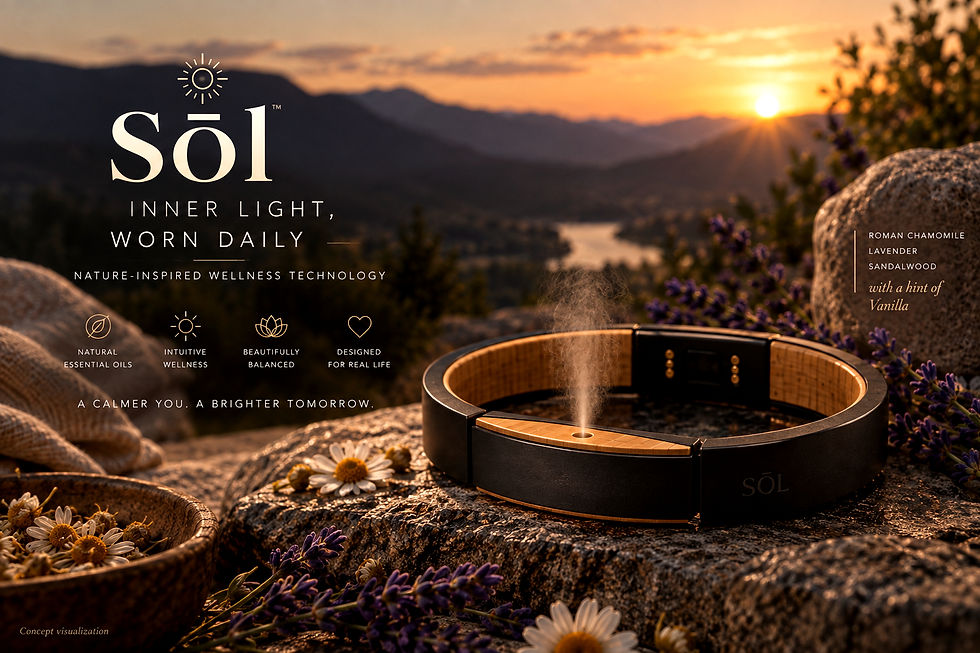
Sōl reads your heart rate variability in real time — along with your skin's response to stress — to recognize when you're genuinely under strain. But instead of just showing you a number, it responds by releasing a gentle breath of calming aromatherapy, automatically, right when your body needs it.
It takes one of the most honest signals your body produces, and finally does something with it — turning awareness into actual relief, without you having to lift a finger.
Your body has been trying to tell you something all along. Sōl is the first wearable designed to listen — and to answer.
Your body knows the storm. Sōl brings the calm.

— The Sōl Team


Comments